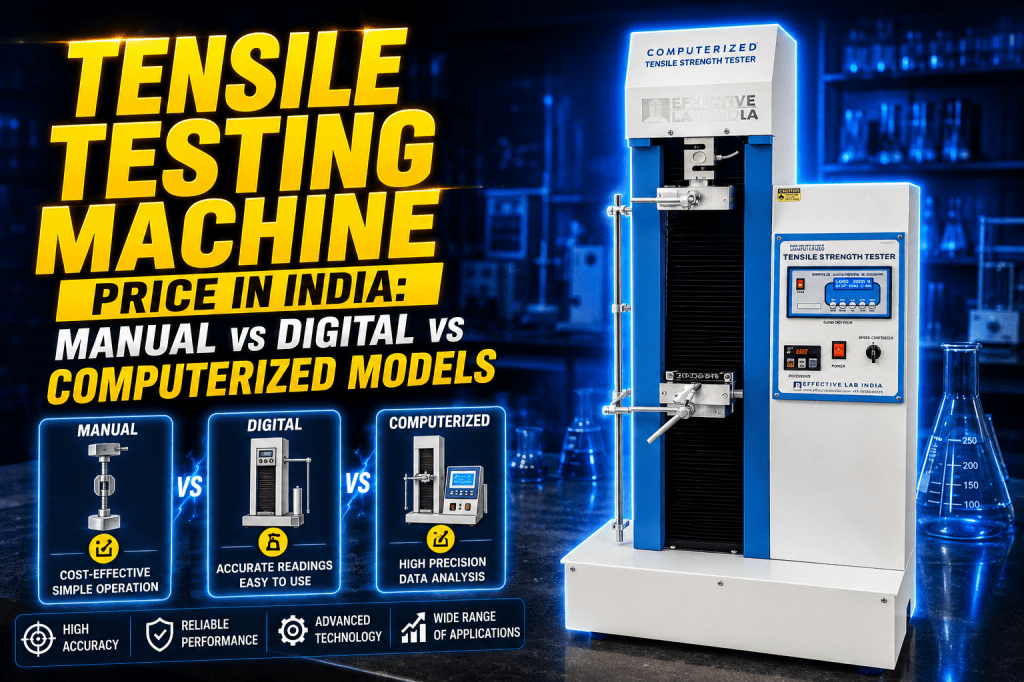
Introduction to Tensile Testing Machine Price in India: If you are setting up a material testing laboratory, managing quality control in a manufacturing plant, or procuring testing equipment for a research institution, one question inevitably rises to the top of your checklist: What is the tensile testing machine price in India, and which model suits my requirements best?
Tensile testing machines, also called Universal Testing Machines (UTM) or tensile strength testing machines, are among the most critical instruments in any quality assurance setup. They measure how materials respond to tensile forces, helping manufacturers determine tensile strength, elongation, yield point, and breaking load of materials such as metals, plastics, rubber, textiles, films, adhesives, and composites.
With India’s manufacturing sector growing rapidly across industries such as automotive, packaging, textiles, construction, and medical devices, the demand for tensile testing equipment has surged. However, the market offers a wide range of machines — from basic manual models to sophisticated computerized systems — each with a distinct price point and set of capabilities.
This guide breaks down everything you need to know before making a purchasing decision.
Suggested Post:
- GSM Calculator for Fabric, Paper, Packaging & Non-Woven Material Testing
- Bursting Strength Tester Supplier: Machine Types, Cost & Applications for Industries
- Leading Laboratory Equipment Suppliers Offering Advanced Testing Solutions
Tensile Testing Machine: Overview, Types & Price Differences Explained
A tensile testing machine applies a controlled uniaxial force to a test specimen and measures its mechanical response. The machine records data such as peak load, elongation at break, yield strength, and stress-strain curves. This data is used to verify that materials meet industry specifications and safety standards.
The Three Main Types
1. Manual Tensile Testing Machine Manual machines rely on hand-operated mechanisms or basic motorized drives without digital interfaces. They are best suited for simple, repetitive tests where high precision is not the primary requirement. These are widely used in small-scale industries, training labs, and budget-constrained setups.
2. Digital Tensile Testing Machine Digital models feature electronic load cells, digital displays, and automated data capture. They eliminate human reading errors and offer better repeatability than manual systems. These machines are ideal for mid-sized manufacturers and quality labs that need reliable test data without investing in full computer integration.
3. Computerized Tensile Strength Testing Machine Computerized models are fully integrated systems where the machine is connected to a PC or laptop running dedicated testing software. They generate real-time stress-strain graphs, store test records, produce formatted test reports, and often support multiple test standards simultaneously. These are the gold standard for NABL-accredited labs, export-oriented manufacturers, and R&D facilities.
Price Difference Overview
The tensile testing machine price in India varies significantly based on type, capacity, and configuration:
| Machine Type | Approximate Price Range (INR) |
|---|---|
| Manual Tensile Testing Machine | ₹25,000 – ₹1,50,000 |
| Digital Tensile Testing Machine | ₹1,50,000 – ₹5,00,000 |
| Computerized Tensile Testing Machine | ₹5,00,000 – ₹25,00,000+ |
Prices vary further based on load capacity (from 1 kN to 2000 kN), brand, accessories, and compliance certifications.
Tensile Strength Testing Machine: Key Features That Impact Cost & Performance
Understanding which features drive the cost of a tensile strength testing machine helps buyers make smarter investment decisions. Here are the primary factors:
Load Cell Capacity
The load cell is the heart of any tensile testing machine. Machines with higher capacity load cells — capable of testing heavy metals or structural components — cost significantly more than those designed for lightweight materials like films or fabrics. Load capacities typically range from 1 kN (for thin films and fibres) to 2000 kN (for structural steel and cables).
Drive Mechanism
Electromechanical drive systems offer precise crosshead speed control and are suitable for most tensile applications. Hydraulic drive systems are used for very high-load applications but come at a higher cost and require more maintenance.
Accuracy & Calibration Class
Machines compliant with ISO 7500-1 Class 0.5 or Class 1 offer higher measurement accuracy and command higher prices. Labs seeking NABL accreditation or testing to international standards like ASTM E8, ISO 6892, IS 1608, or EN 10002 must invest in machines that meet these accuracy requirements.
Software Capabilities
Computerized machines with advanced software that supports multiple test standards, multilingual reporting, automatic pass/fail judgments, and statistical analysis (mean, standard deviation, Cpk) are priced higher — but they dramatically reduce reporting time and human error.
Grips and Fixtures
The type of grips included — pneumatic, manual wedge, self-tightening, or custom fixtures for textiles, films, or wires — significantly affects the total cost. Universal grip sets for multiple material types add both versatility and expense.
Manual vs Digital Tensile Testing Machine: Price Comparison & Use Cases
Choosing between a manual and digital tensile testing machine depends on your testing volume, accuracy requirements, and budget constraints.
Manual Tensile Testing Machine
Price Range: ₹25,000 – ₹1,50,000
Manual machines are operated by the technician, with results often read off an analog dial or manually recorded. They require a skilled operator to ensure consistency and are not suitable for high-throughput testing environments.
Best suited for:
- Educational institutions and training labs
- Small-scale textile or rubber product manufacturers
- Basic incoming material verification without compliance requirements
- Field testing where portability matters
Limitations: Prone to operator error, limited data storage, no automatic report generation, and difficult to audit.
Digital Tensile Testing Machine
Price Range: ₹1,50,000 – ₹5,00,000
Digital machines incorporate a calibrated load cell, digital display panel, motorized crosshead drive, and basic data output. Many models include USB or RS232 ports for data export. They offer significantly better repeatability than manual machines and are far easier to operate.
Best suited for:
- Mid-sized packaging, textile, and plastic manufacturing units
- In-house QC labs with moderate testing volumes
- Buyers who need reliable data but don’t require full software integration
- Industries where test reports are generated externally
Advantages over manual: Eliminates dial-reading errors, supports preset speed and load parameters, and provides faster test cycles.
Computerized Tensile Strength Testing Machine: Advanced Features & Pricing Insights
A computerized tensile strength testing machine represents the highest tier of tensile testing capability available in the Indian market. These machines are fully integrated with PC-based software that controls the entire test cycle, captures data in real time, and generates comprehensive reports automatically.
Price Range: ₹5,00,000 – ₹25,00,000+
What Justifies the Higher Price?
Real-Time Stress-Strain Graphing: The software plots load vs. extension curves live during the test, allowing engineers to observe material behaviour at every stage — elastic deformation, yielding, necking, and fracture.
Multi-Standard Compliance: A single computerized machine can be configured to run tests as per ASTM, ISO, BIS, DIN, JIS, and other international standards — saving labs from purchasing multiple machines.
Automated Report Generation: Test reports with specimen ID, operator name, test conditions, graphical output, and pass/fail judgments are generated automatically and stored in a searchable database — critical for ISO 9001, IATF 16949, and NABL compliance.
Statistical Process Control (SPC): Built-in SPC tools help quality managers track trends, identify process drift, and take corrective action before defective products reach the market.
Remote Calibration & Diagnostics: Many premium computerized systems support remote calibration verification and software updates, reducing downtime and service costs.
Best suited for:
- NABL-accredited and third-party testing laboratories
- Automotive and aerospace component manufacturers
- Export-oriented industries with international buyer audits
- R&D departments in universities and material science institutes
- Medical device manufacturers requiring 21 CFR Part 11-compliant data integrity
How to Choose the Right Tensile Testing Machine Based on Budget & Application
Selecting the correct machine requires matching your testing needs with your budget and long-term goals. Here is a structured approach:
Step 1: Define Your Material Type
Different materials require different grips, load ranges, and speed profiles. Metals need high-capacity machines; films and fibres need low-capacity, high-sensitivity setups. Confirm the material types you will test before setting a budget.
Step 2: Determine Required Load Capacity
Always choose a machine whose maximum load capacity is at least 20–30% above your highest expected test load. Overloading a machine damages the load cell and compromises accuracy.
Step 3: Assess Compliance Requirements
If you supply to international buyers, hold NABL accreditation, or are regulated under BIS, CE, or FDA frameworks, a computerized machine with traceable calibration and audit-ready reporting is non-negotiable.
Step 4: Calculate Total Cost of Ownership
The purchase price is only part of the equation. Factor in calibration costs, consumable grips, software licensing, annual maintenance contracts (AMC), and operator training. A slightly more expensive machine with better after-sales support often costs less over five years than a cheap machine with poor service.
Step 5: Shortlist Vendors with Proven Track Records
Choose suppliers who offer in-house calibration, application-specific consultation, and documented references from similar industries. Avoid vendors who cannot provide calibration certificates traceable to NPL (National Physical Laboratory, India) or equivalent bodies.
Buy a Tensile Testing Machine from Effective Lab India
When it comes to sourcing a reliable, accurate, and competitively priced tensile testing machine in India, Effective Lab India is one of the country’s most trusted names in material testing instrumentation.
Effective Lab India offers the complete spectrum of tensile testing solutions — from entry-level manual machines for training labs to advanced computerized universal testing machines for NABL-accredited facilities. Their product line covers load capacities from 1 kN to 600 kN, with custom configurations available for specialized applications in textiles, packaging, rubber, plastics, metals, and medical materials.
What sets Effective Lab India apart is their commitment to end-to-end customer support. Their technical team assists buyers through the entire journey — from application assessment and machine selection to installation, operator training, and annual calibration. Every instrument is supplied with a NABL-traceable calibration certificate, ensuring your lab’s test results are audit-ready from day one.
For industries where precision drives profitability — automotive, pharmaceuticals, packaging, textiles, and construction — Effective Lab India delivers instruments engineered to perform, priced to compete.
Whether you are buying your first tensile testing machine or upgrading an aging system, Effective Lab India provides transparent pricing, genuine technical guidance, and after-sales support that stands behind every machine they deliver.
Conclusion
The tensile testing machine price in India spans a wide range — from affordable manual instruments to high-performance computerized systems — and every price point serves a specific set of testing needs. Understanding the differences between manual, digital, and computerized models, and aligning your choice with your material type, compliance requirements, and testing volume, is the key to a smart investment.
For quality managers, lab technicians, and procurement professionals, investing in the right tensile strength testing machine is not a cost — it is a safeguard for your product quality, your customer relationships, and your brand reputation. Partner with a supplier like Effective Lab India who brings both technical expertise and industry-grade equipment to the table, and you will have a testing solution that delivers accurate, reliable results for years to come.


Leave a Reply